Why a Racing Weekend Has More Than One Clock
Racing weekend sessions serve different purposes. Learn what practice, qualifying, and race timing reveal, and how to interpret each session without overreading a lap.
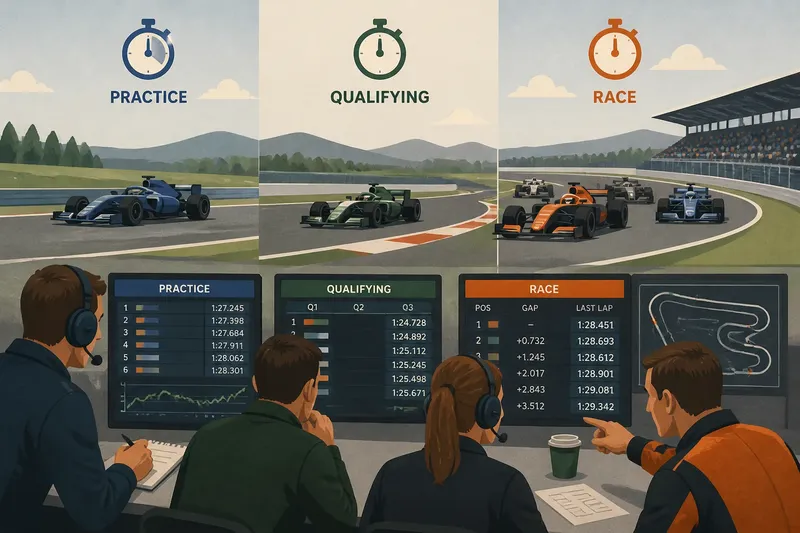
What does a lap time actually tell you during a racing weekend? The answer depends on whether the car is in practice, qualifying, or the race, because each session gives the clock a different job. A practice lap helps teams assess the car; qualifying records performance under its session rules; a race lap belongs to a live contest.
That distinction matters when a timing screen puts several kinds of information side by side. To read it well, focus on what teams and drivers are trying to learn or accomplish in each session, rather than treating one fast time as a verdict on the weekend.
Practice times show performance in context
Practice gives teams track time to examine how the car behaves in the conditions available. Drivers may compare setup choices, observe tire behavior, or build familiarity with a circuit. A quick lap is one useful observation, but the session is also about gathering information.
The time alone does not reveal what produced it. A car may be running a different setup or tire, or the driver may be following a plan that emphasizes consistent laps rather than a single fast attempt. Without that context, a ranking is a limited comparison, not a complete account of the car’s race potential.
Look for patterns across a run. If a driver’s times become more consistent, that may indicate a more settled approach; repeated trips to the garage, by contrast, leave questions the timing screen cannot answer. The team’s next choices depend on what it learns from the car, not just where the driver sits on a live board.
Practice also reveals how the track is behaving for the drivers. A clear line early in a session can become harder to use as conditions change or traffic builds. Teams can adapt what they try and compare later running with earlier observations.
When you watch practice, ask what the driver appears to be working on and whether the pace holds across a run.
Qualifying records performance under a specific format
Qualifying is organized around a session result, often a starting position, according to the event’s rules. Some formats use multiple timed segments; others arrange the session differently. Check the schedule and regulations to see exactly what the session determines.
A qualifying lap must count within those rules to affect the result. Drivers need to find an opportunity to run, place the car on track, and complete a valid attempt. Traffic, timing, and a disrupted lap can shape what appears on the final classification.
Conditions can change as qualifying proceeds, and drivers may encounter different track space or traffic. Those differences make the session more than a simple comparison of identical laps, even though its official result is clear once the applicable rules are applied.
Imagine a driver whose early attempts are interrupted by traffic but whose final lap is clear and valid. The observable result is that the final lap determines the driver’s session position under the format; the earlier times explain the route to that result, but do not replace it.
Race timing describes a changing contest
In a race, a lap time sits within a contest involving other cars and the event’s rules. A driver may choose a different pace to manage the car, respond to traffic, or pursue an opportunity. The quickest lap is not automatically the most useful choice at every moment.
Read lap times alongside position and the gap to nearby competitors. A slower lap may reflect a car ahead or a deliberate response to conditions, rather than a sudden loss of ability. The screen reports elapsed time; the race situation helps explain why it changed.
Practice can help teams understand the car, but it cannot reproduce every decision that emerges in competition. Race timing must be interpreted as part of an unfolding event, not as a continuation of a practice leaderboard.
The weekend schedule explains how sessions connect
Practice, qualifying, and the race are related, but their results answer different questions. Practice informs preparation; qualifying produces a result defined by the format; the race develops through competition. The event schedule and sporting regulations establish how those parts fit together.
Weekends do not all use the same structure. Some include additional sessions or a separate short race, and the role of a session can vary by series or event. Check the official schedule rather than assuming that a familiar session name always means the same thing.
Say you are following a driver who posts strong practice times, has a disrupted qualifying session, and then spends the race among several close competitors. The starting information is the practice pattern, the qualifying result is the outcome under that session’s rules, and the race position changes as the contest unfolds. Each observation describes a different part of the weekend, so one does not erase the others.
Before a session begins, note what its result is meant to establish. That small check makes later timing changes easier to interpret.
Timing screens answer different questions at once
A screen may show a current lap, best lap, position, or gap. A best lap reports an individual time within the session; position reports the order under its rules; a gap compares a driver with a reference point. These fields are related, but they are not interchangeable.
Use this decision list when a live board changes:
- Check the session name. If it is practice, treat the order as information about current running; if it is qualifying, check what the format’s result establishes; if it is a race, read the order as part of the competition.
- Check the column heading. If it shows a lap time, interpret elapsed time; if it shows position, interpret session order; if it shows a gap, identify the reference car before comparing.
- Check whether the session is still live. If drivers are still completing attempts, treat the board as provisional; if the session has ended, consult the final classification.
- Check which drivers have had an opportunity to post a relevant time. If some have not, avoid treating the current ranking as a settled comparison; if all relevant attempts are complete, compare the recorded result within the session’s rules.
- Check whether the comparison uses the same session and measure. If it does, the times or positions can be compared on that basis; if it does not, separate the observations instead of combining them.
- Check the event schedule when the session’s purpose is unclear. If the schedule identifies a grid-setting or race session, use that definition; if it does not, consult the series regulations before interpreting the result.
These checks keep a striking number from being asked to answer a question it was never meant to settle.
What can a session result tell you about the weekend?
What does a fast practice lap tell me?
It tells you that the driver recorded a quick lap in that practice session. The time is most useful alongside the run’s consistency and any available context about the car’s program, tires, or conditions.
Why might qualifying and race times differ?
Qualifying and the race have different demands, and traffic, competition, and changing conditions affect how a lap is produced. Read each time in the context of its session rather than expecting the same pace to appear in both.
How should I interpret a live timing position?
First identify the session and the column being shown, then check whether the session is complete. A live position can change as more attempts are recorded or as the race develops.
Where can I confirm what a session determines?
Check the official event schedule and the series’ sporting regulations. They explain the session structure and clarify what each result is used for.
Read each time according to its session
A practice time is most informative as part of a team’s work on the car. A qualifying time belongs to a result governed by that event’s format, while a race time belongs to a developing contest. Keeping those distinctions in view makes racing weekend timing easier to follow.
When a number catches your attention, identify its session, its measure, and whether the result is final. That quick check gives the time a useful meaning without asking it to explain more than it can.