From Flag Signals to the Race Control Room
Learn how race control communication connects trackside flags, officials, radios, and displays so you can tell how a warning reaches drivers and teams.
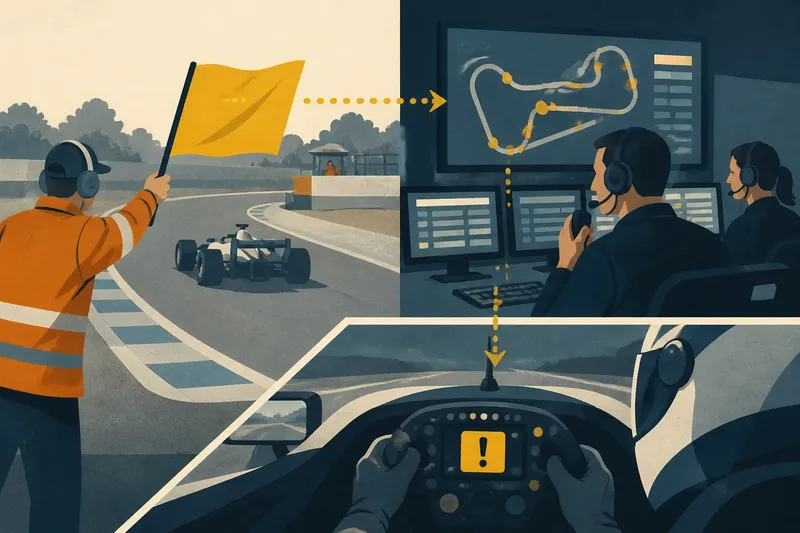
How does race control communication turn a marshal’s view of a hazard into a message drivers can use? It connects trackside flags, reports to race control, and approved radio or electronic channels, with each route serving a different purpose.
Trackside flags give drivers a local warning
A marshal displays a flag where approaching drivers can see it. A yellow flag warns of a hazard in that area, while a checkered flag signals the end of a session or race. The driver receives a visible cue without needing a radio or dashboard display.
That local focus is useful, but it limits what a flag can communicate. A warning at one post may not tell officials elsewhere what happened, and a flag alone does not create a shared record or coordinate decisions around the circuit.
When watching a broadcast, note where the signal appears and which section of track it concerns.
Race control connects reports from around the circuit
Race control provides a central point for monitoring the event, receiving reports from trackside officials, and coordinating decisions. It does not replace a marshal who can see a stopped car at a corner. Instead, it gives that observation a route to officials considering the wider situation.
Observation and decision are separate roles. A marshal reports what is visible; the race director and relevant officials assess what response is appropriate. A report is not automatically an instruction, and one view may not explain an entire incident.
Central coordination depends on clear, timely reports. A control room can compare information, but it cannot see through a barrier or replace an official’s direct view.
Radios and displays carry information farther
Radio lets officials pass observations and instructions without relying only on visible signals. Depending on the event’s arrangements, communications may connect trackside posts with race control and convey information to teams or drivers. Electronic displays and dashboard indicators offer another visual route, allowing a driver to notice a signal while watching the circuit.
Each channel has different strengths. Radio can add context, such as an incident’s location, but spoken messages depend on clear language, timing, and reception. Flags and displays offer compact visual cues, though they may provide less explanation. Using channels together can reinforce a message when their meanings agree.
Imagine a marshal sees debris near a corner and radios its location to race control. Officials assess that report, then use the event’s approved channels to communicate the relevant status; drivers approaching the affected sector see a warning. The marshal supplies the observation, race control coordinates the response, and the warning tells drivers what applies on track.
Race control communication depends on the need
A local visual signal, a central coordination network, and a layered system combining visual, radio, and electronic communication solve different problems. None makes the others obsolete. The useful question is whether the message must be seen in one place, coordinated across the venue, or delivered through several routes.
- Local flags: If the message concerns a visible condition at a particular section, use the flag as the immediate cue; if drivers or officials need more context, pass a report through the event’s communication procedures as well.
- Central coordination: If reports from different posts need to be compared, bring them to race control; if the issue is visible only at one post, retain the trackside official’s direct observation rather than relying on central screens alone.
- Layered communication: If several groups need the same status, use the approved channels with consistent meanings; if a channel cannot reach its intended audience, use the event’s established alternative rather than assuming the message was received.
- Radio reports: If an incident report lacks a location or clear description, request clarification before treating it as a complete account; if the details are clear, pass them to the officials responsible for assessing the response.
- Electronic displays: If a display gives drivers a concise signal, use it for that visual cue; if the situation needs explanation, pair it with the event’s approved communication route rather than asking the display to carry the full account.
- Shared meanings: If a signal’s meaning is defined by the event’s rules, interpret it under those rules; if a broadcast leaves its meaning or scope unclear, consult the event’s official explanation instead of guessing.
To follow a race broadcast, begin with the visible signal, then consider what report may have reached race control and how officials communicated the resulting status. This separates what a driver saw from how officials assembled their understanding.
How does race control communication reach drivers?
Why are flags not enough on their own?
A flag gives drivers a local visual message but cannot readily explain an incident or coordinate officials across a circuit. Reports and decisions need other routes when the situation requires wider oversight.
What does the race control room contribute?
It provides a central point for receiving reports, monitoring the event, and coordinating decisions. Trackside officials remain essential because they supply observations from places central control cannot directly occupy.
Do radios replace trackside signals?
No. Radio carries spoken information between people, while a flag or display gives drivers a visual cue. Events may use both because their roles differ.
How can viewers tell what a message applies to?
Consider who needs the information and where it applies: one corner, a larger part of the circuit, or officials coordinating the event. The route can help distinguish a local warning from a report or wider status.
Shared meanings keep the system understandable
A message is useful when its recipients understand what it means and where it applies. Standardized signals support that shared understanding, while radio procedures and electronic displays extend how information travels. The exact rules and equipment depend on the event and its organizers.
To understand race control communication, separate the person who observes, the officials who coordinate, and the channel that carries the message. Flags show drivers a status at the track; the control room connects local reports to decisions affecting more of the event. When a broadcast does not explain a signal’s scope, the event’s rules are a better guide than assumptions based on the channel alone.